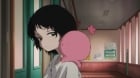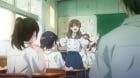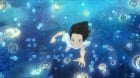
Columnist Andrew Osmond gives his first impressions on the new series about 2 inseparable best friends… until one returns from the mountains and is no longer himself, now streaming on Netflix.
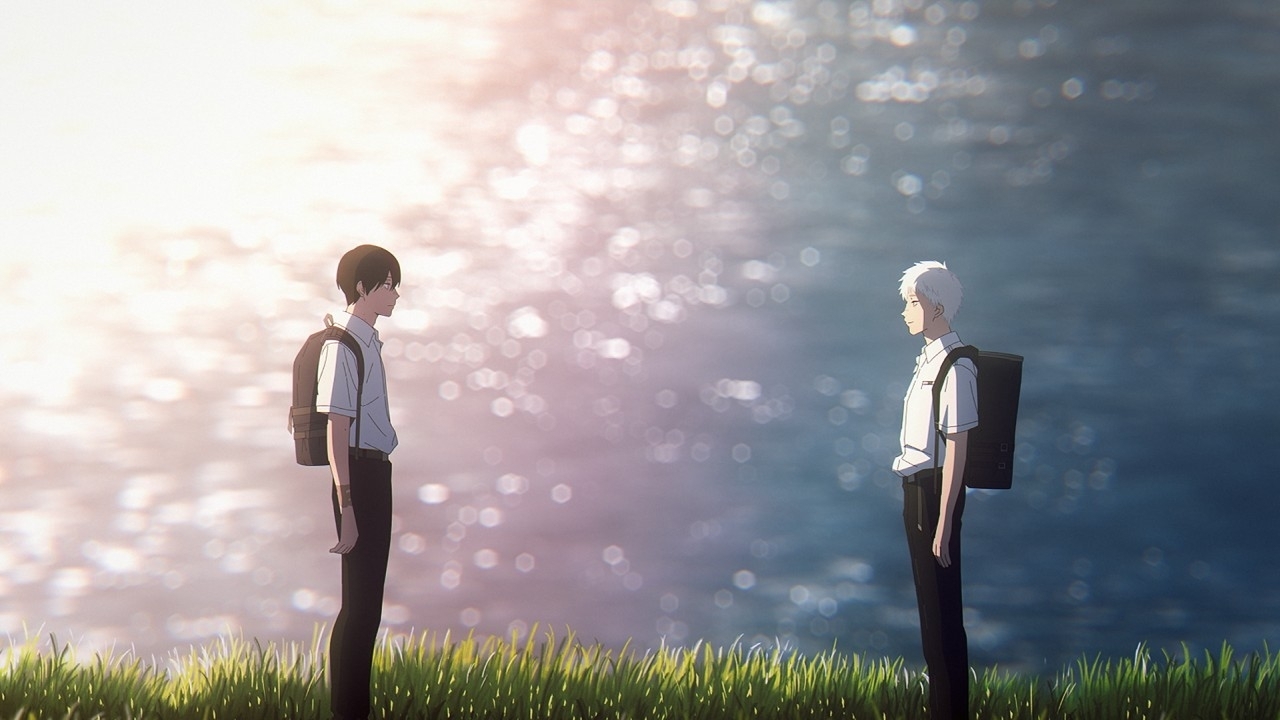
There’s something strange in the woods today. It’s odd that anime, of all media, should revive that primal fear in 2025. One of the most famous anime took that fear and inverted it, made it beautiful, wonderful and funny too. I’m talking about Hayao Miyazaki’s My Neighbor Totoro, where a huge hairy god stood beside two girls at a bus stop in the woods. Then the god took off in a cat that was a bus, or a bus that was a cat. Totoro taught kids that magic forests are marvelous, and you shouldn’t fear them.
Miyazaki said Totoro partly came from his own experiences of moving with his family to a house surrounded by woods. In a Japanese book, “The Place Where Totoro Was Born,” Miyazaki said he walked those woods and “realized there was a feeling that someone was there. I felt the presence of the forest… Like, ‘The wood is pretending not to notice me today.’ There are presences everywhere, right?” Miyazaki’s attitude to those presences is summed up in Totoro’s title; they’re neighbors.
In contrast, The Summer Hikaru Died, now streaming on Netflix, is the stuff of campfire scare stories. In Part 2, a group of schoolkids living deep in the Japanese countryside hear a patch of nearby woodland is spooky. One boy says he’s scared, so his classmates band together and walk him home. And it’s fine – the woods are ordinary, nothing happens. But then, after the grateful boy leaves, the other kids must walk back that way…
And it’s while they’re returning that one kid, a boy called Yoshiki sees something in the dark in the trees. It’s a zigzag in mid-air, as if an animator had squiggled on shadows. It’s as unassuming as it’s impossible. The boy peers longer, and the squiggle moves. Now you could see it as a distorted human, with a long stick-neck, tiny head and feather-duster hair, pale and featureless.
With a crunching crack, the thing’s head swings in an arc on the lever of its neck. For a moment, we glimpse its parchment face, like an engraving. The boy can’t move, and we share the perspective of the thing approaching, rushing up, pouncing! And then – Yoshiki hears his name shouted by his schoolmate, his best friend Hikaru. He’s the one person who can save Yoshiki from this horror.
That’s because Hikaru’s a horror himself.
As of writing, we’re three episodes into The Summer Hikaru Died, but it’s already picked up a buzz. It’s being screened internationally by Crunchyroll, but the fact it’s a weekly serial should clue you in that it’s tied to TV broadcasts in Japan – it’s shown on Nippon TV in this case. It’s produced by Cygames Pictures, a subsidiary of the mobile game company Cygames, which is best known for one of the most bizarre game-anime franchises imaginable. Uma Musume Pretty Derby is about horse girls – horses reborn as girls who race each other round stadiums. Why? Because Japan.
The Summer Hikaru Died is largely the work of Ryohei Takeshita, who’s both its director and lead writer. Takeshita also directed the 2024 series Jellyfish Can’t Swim in the Night, about the misfortunes of misfit girl musicians in Tokyo. It took harsh criticism from reviewers, but I found it stylish, funny and endearing, with a “terrible singing” scene that’s howlingly funny and heroically uplifting. It’s on HIDIVE and here are the titles.
However, Takeshita didn’t create The Summer Hikaru Died, from a manga by the artist Mokumoruken. As is generally the case with manga adaptations, any fan who wants to skip ahead in the story can do so – the strip’s already being translated into English by the publisher Yen Press. But while the manga readers may have a “fuller” understanding of the story’s themes – though it’s not finished yet – the first impressions are still important, like a squiggle between trees.
The first minutes lay out the premise. Half a year before the main story, the boy Hikaru was lost in woods on a mountain, said to be forbidden territory. He was found and brought home, but Yoshiki, who’s been close to him since childhood, has realized something terrible. This boy isn’t Hikaru anymore.
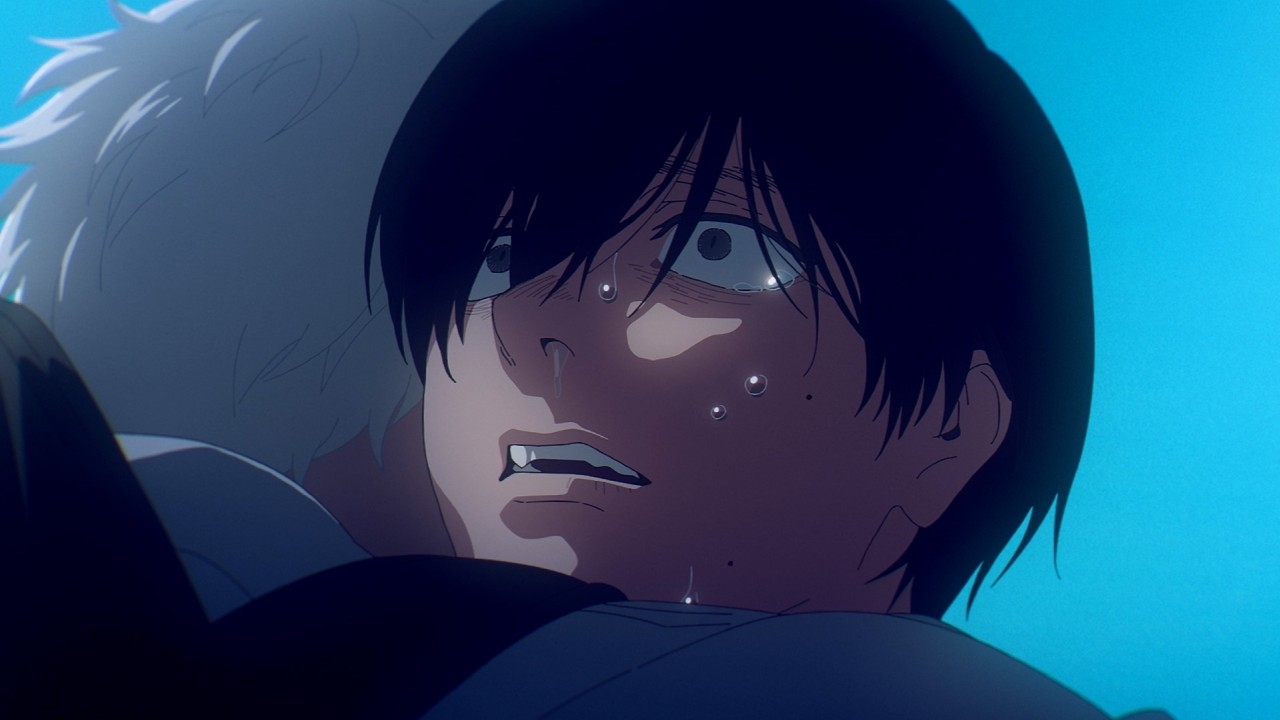
Rather, it’s an entity from the woods that’s possessed Hikaru’s dead body, along with his mind and memories. The new Hikaru’s no affectless pod person. He talks like Hikaru, laughs like Hikaru, and is goofy and affectionate like Hikaru. But when Yoshiki tells him he knows he’s not Hikaru, the fake boy sobs and hugs him, shadowy tendrils oozing from his face in red and silver. “I don’t want to kill you,” he says.
What would be the end of a more conventional horror story is here the starting point. Yoshiki knows his friend has been replaced; what will he do with this knowledge? Amazingly Yoshiki opts to go along with it. It’s a decision not from denial or apathy, but from grief and loss. Having lost the true Hikaru, Yoshiki can’t bear to lose the replica too.
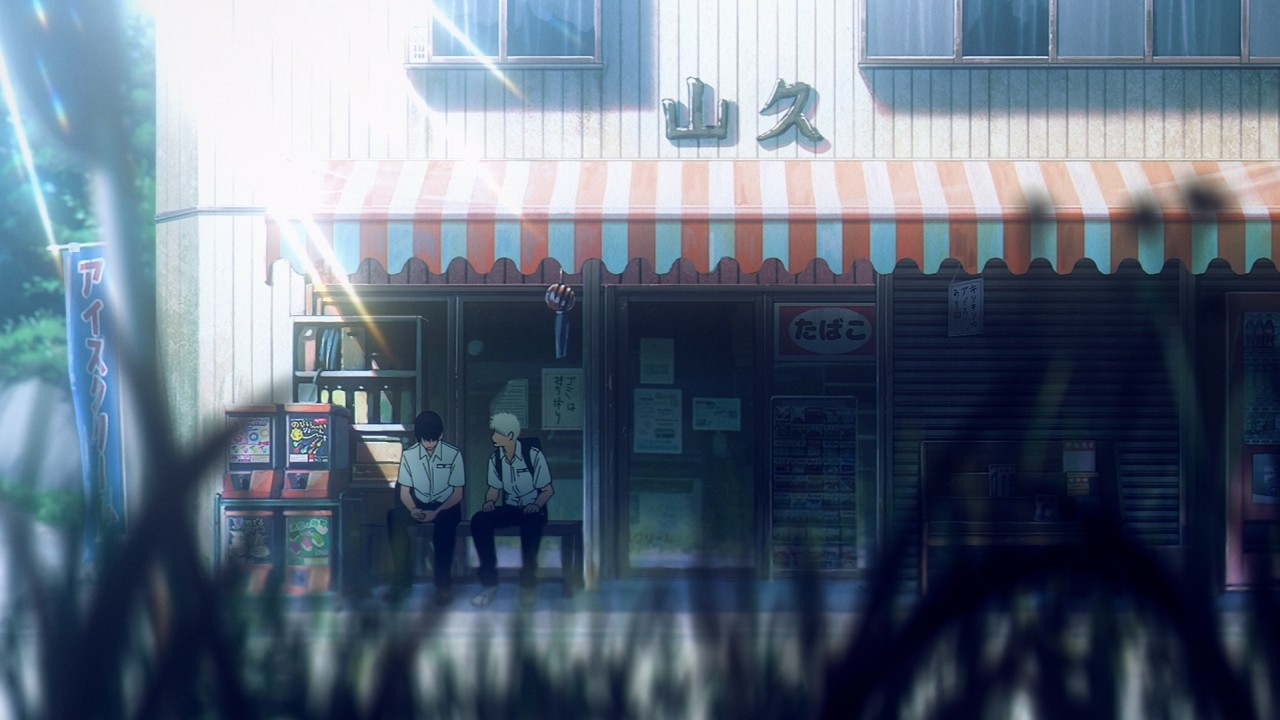
This decision, though, doesn’t bring him peace, but ongoing nausea, as if he’s in a spiritual uncanny valley. One of the first-season Rick and Morty episodes, “Rick Potion #9,” had the duo fleeing their destroyed Earth. They infiltrate a close substitute Earth in a parallel universe, a home and family that’s not quite their home and family. The scene’s excerpted here. Rick takes it in his stride, while Morty wanders through “normality,” the home and people he’s always “known,” in an alienated, shell-shocked funk. It was a thrilling, horrifying moment, whose emotional impact was largely forgotten after.
Hikaru, though, leans into Yoshiki’s nausea, and the results are beautiful. There’s a scene in the first episode, for instance, where the boys are walking home. Suddenly Yoshiki’s subjective world becomes unstuck, sounds and lights congealing grotesquely. The soundscape is magnificently horrible.
Much of the series is led by its dissonant editing from image to image. The dark subject-matter may suggest Satoshi Kon’s work, but I was reminded of Naoko Yamada’s film A Silent Voice. The editing is fragmented and oblique, a disjointed processing of experience. Hikaru, though, goes beyond Silent Voice to inject mocking gross-outs, with close-ups of characters’ mouths and teeth.
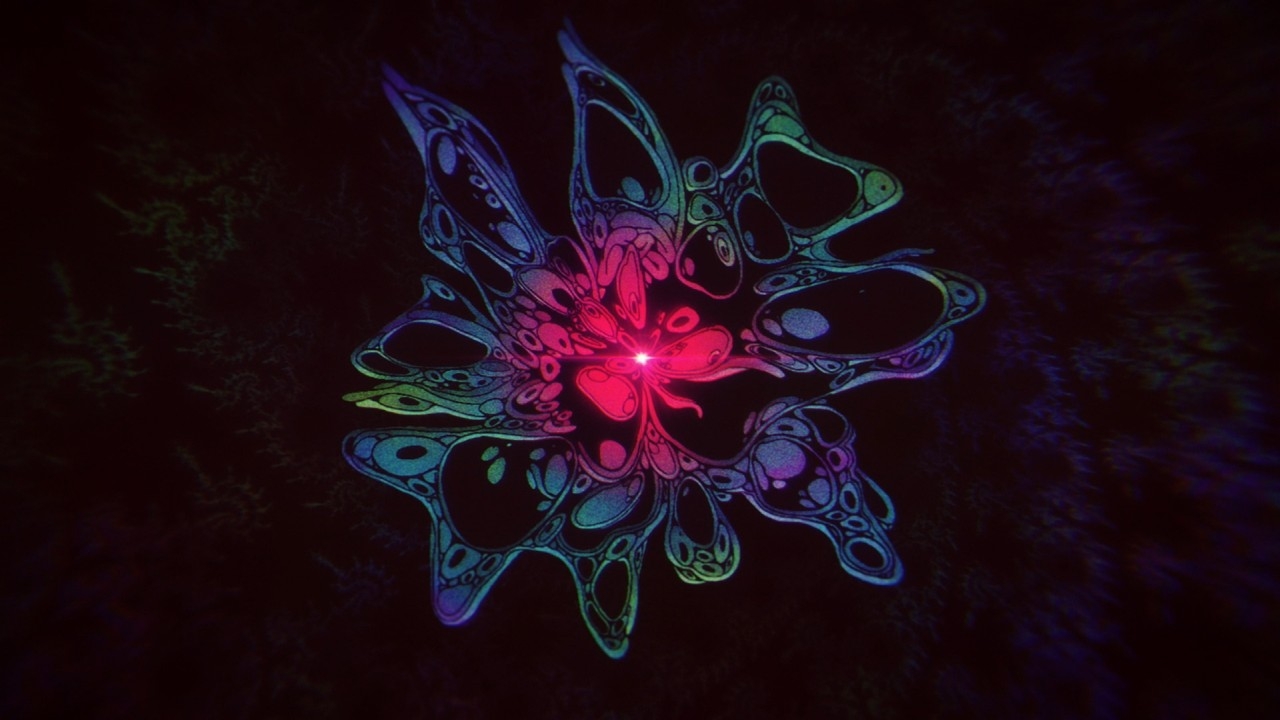
It also adds lyrical abstraction. There are frames of rogue line-drawings, of the kind that many fans first met in the befuddling TV end to Evangelion. They figure in an astonishing Hikaru scene, set not in woods but in a darkened classroom, the epitome of anime confessionals.
Some dark anime, such as Death Note or Parasyte: The Maxim, have boy characters concealing deadly secrets from the grown-up world. Hikaru, though, seems out to subvert this. Yoshiki may have his traumatizing knowledge about his friend, yet there’s the suggestion that many of the adults know the real deep, dark secrets of the world. In short order, Yoshiki confesses his secrets to a grown-up who suggests everything he’s going through has happened before, that it’s a hidden part of normalcy. That’s far worse than a disruption to a sane world.
Audiences will have seen elements of Hikaru too, of course. The idea of dead people being “returned” by nature in a changed state has shades of Steven King’s Pet Semetary. In anime, the “body snatcher” scenario is part of the 2022 series Summertime Rendering, which I’ve covered previously. But that (very good) series minimized the uncanny suspense of the scenario, focusing on time-twisting action-adventure.
Rather, Hikaru smacks of sci-fi stories where grieving people encounter the simulacra of loved ones. That was the basis for one of the best Black Mirror episodes, “Be Right Back,” and also for a flawed but interesting anime romance film, 2013’s HAL by the WIT studio.
However, Hikaru also echoes some anime dramas where characters can’t be with the person they love, so they choose to be with a substitute instead. One pungent example is the 2017 series Scum’s Wish, where two students, each obsessed with teachers, must make do with each other instead. A similar idea was played for laughs in 2014’s Nisekoi: Fake Love.
Then there’s how Hikaru suggests an alternate version of itself even as it plays. By the end of Part 1, there seems no doubt that what Yoshiki perceives to be true is true; Hikaru has died and been replaced by a supernatural entity. And yet with a few adjustments, this could be the story of one troubled boy’s emotional breakdown, his delusion that his friend has been replaced. Or perhaps two boys’ delusions, feeding off each other with fearful passion.
And that brings up the aspect of the series that has plainly drawn many of its fans. That’s its sensual homoeroticism. In a previous column, I pointed to the gap between what many fans want from anime – queerness, confirmed and affirmed – and what many of their creators seem prepared to give. I mentioned Naoko Yamada earlier. When I interviewed her in 2022, and asked her about her film Liz and the Blue Bird – which fans often acclaim as a lesbian drama – she’d only speak of the “intensity” of the girls’ feelings, rather than confirming they were gay.
But with Hikaru, it’s well-nigh impossible to deny the show’s gayness. It invites fanfic writers to go to the intimate scenes – the classroom encounter mentioned earlier, and a squidgy body-horror scene behind a school gym – and tear off their fig leaves of metaphor. Of course, you could link this to the idea of a mental break-down, so that Yoshiki’s perceiving of Hikaru as a magic imposter becomes internalized homophobia… though the fantasy also has the lure of, as a Disney princess would say, letting go.