Columnist Andrew Osmond assesses the newly released Netflix series, its CG production studio, and the proud tradition of anime steampunk.
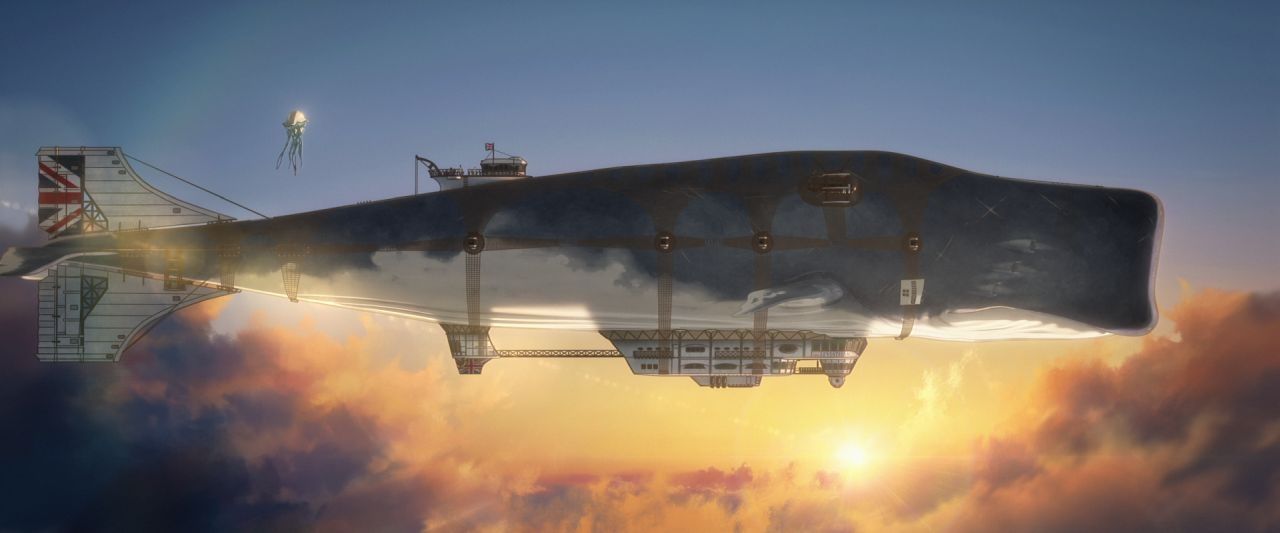
Leviathan, the new 12-episode adventure anime that’s just dropped onto Netflix, is distinctive in several ways. It has a French director, Christophe Ferreira, who trained at the feted Gobelins animation school in Paris, but then went to Japan to learn anime methods. The series isn’t based on a Japanese source but rather on a series of American books by Scott Westerfeld. The story crosses numerous countries, from Switzerland to Siberia, but Japan’s not on the itinerary and no Japanese characters figure in the story.
I review Leviathan further down. However, it’s yet another series to bring up the hoary question of “Is it really anime?” I discussed that when I covered Castlevania, but there’s a provocative new opinion piece on the subject at Anime News Network. It’s by Jerome Mazandarani, a veteran of anime marketing and distribution. He argues that for anime to survive commercially, it must be rethought as a “storytelling medium and aesthetic approach that can transcend geographic boundaries,” and not just as Japanese animation.
Leviathan might be the kind of show he’s thinking of. True, it was animated in Japan, though some fans would balk at calling it “anime” even so. That’s because Leviathan is a CG series, and some fans think anime is traditionally drawn or nothing. Then again, Leviathan was made by Studio Orange, the CG studio with the most cred among anime fans at present. That’s not just my opinion – it’s also the view of Shuzo John Shiota, the President of a rival CG anime studio, Polygon.
Orange’s backlist
I first encountered Orange through its 2017 fantasy series Land of the Lustrous, about a world of people made of precious stones. I found it mostly great, though hampered by an infuriating non-ending. (I’m still waiting for the rest, guys!) Here’s the trailer:
That was followed by Orange’s lengthier Beastars series from 2019. I’d describe this as a specifically “adult” answer to Disney’s Zootopia, with murders and sexual scenes, but also very charming. Based on the manga by Akita Shonen, it focuses on gender issues more than racial ones. One of the main relationships is between a girl rabbit and a boy wolf who struggles with his urge to eat her, depicted both as a literal desire and suggesting a different carnal crime. It’s on Netflix, with the final batch of episodes due next year, and here’s what it looks like.
In 2023, Orange also made the SF-action series Trigun Stampede, which you can find on Crunchyroll. It’s a CG remake of the hugely popular Trigun anime from the 1990s, and as with Beastars, it’ll continue next year.
In all, Orange is already doing what Mazandarani advocates in his column – broadening people’s ideas of what “counts” as anime. The new Leviathan adds an international dimension – as noted earlier, it’s a series without Japanese sources, settings or characters. I’d add that, while Netflix has rated Leviathan “TV-14,” it’s notably less violent or lewd than many – probably most – anime adventure shows, though characters certainly die in the show.
Reimagining the Great War
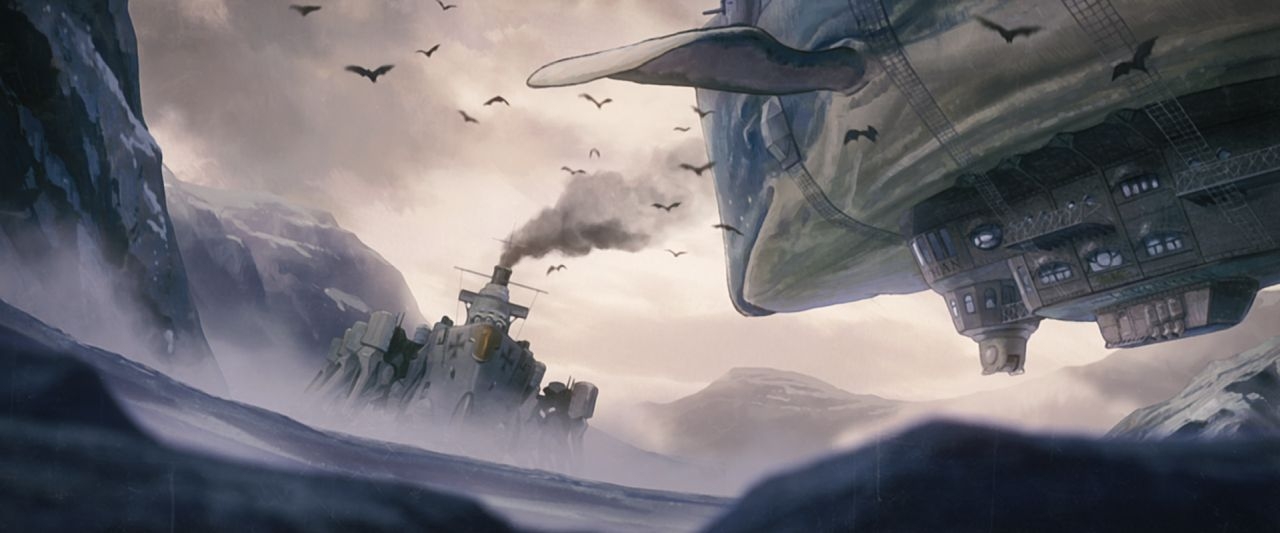
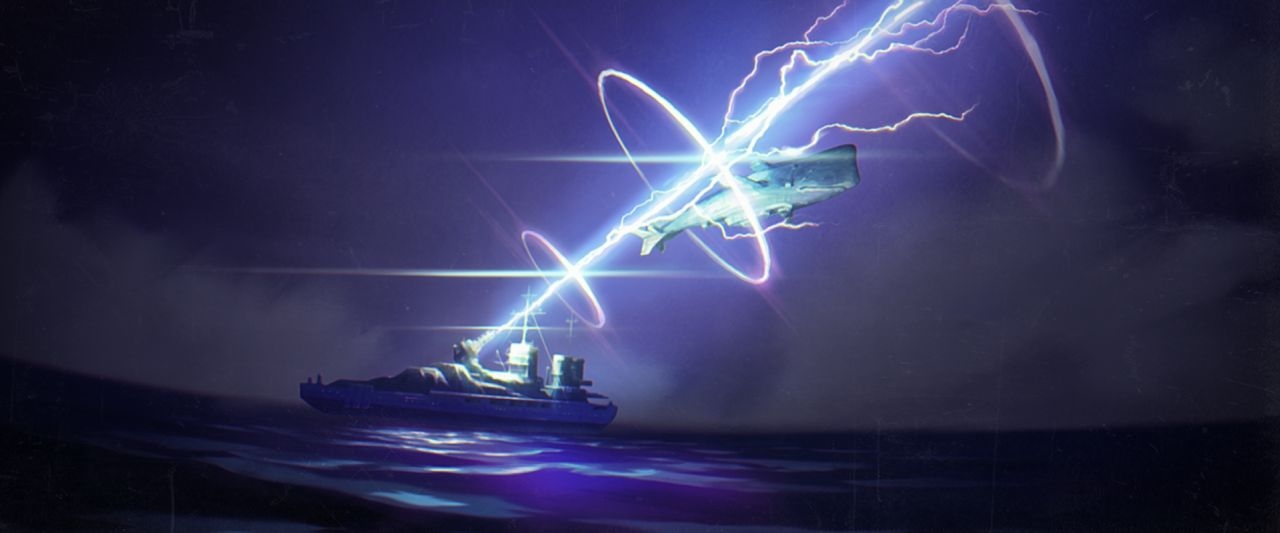
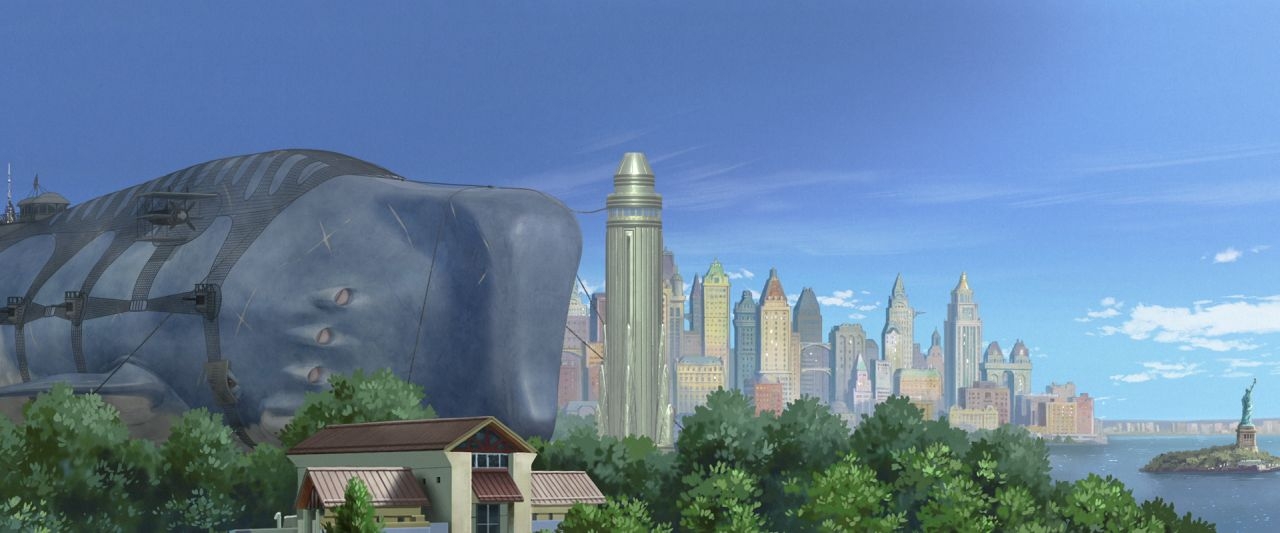
Leviathan is a kind of World War I story, although without trench warfare or the grimness of much of the genre. In this alternate history, rival nations have adopted one of two kinds of science. The “Darwinist” nations, including Britain, have created genetically-engineered animals. They include, bizarrely, a flying whale – the “Leviathan” of the title – which serves as a fleshy dirigible for its human crew. (Hands up anyone thinking of the grumpy space whale in the 1965 cartoon oddity, Pinocchio in Outer Space.)
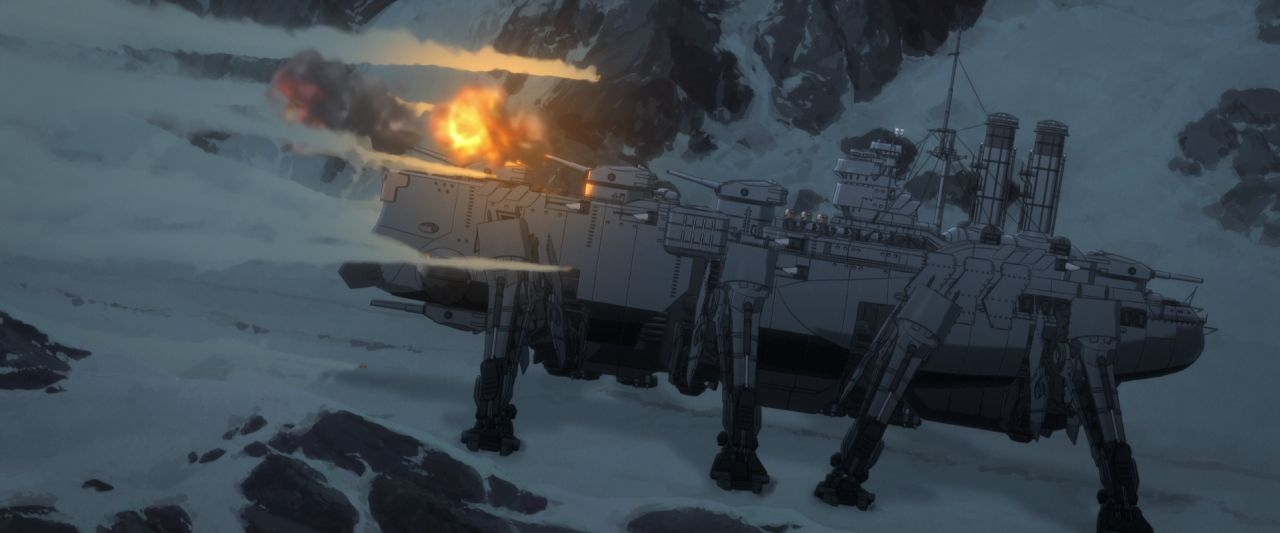
Meanwhile the “Clanker” nations – including Germany – favor overbuilt war machines, including handy biped robot suits that you could compare to the giant robot warriors in anime like Gundam. However, the ones in Leviathan are a bit more believable – they’re boxes on legs like Star Wars mecha, rather than the Godzilla-scaled humanoids beloved by anime.
A quick historical interjection – the most important anime “robot” show, the first Mobile Suit Gundam in 1979, was heavily inspired by World War I. In creating the show’s dueling protagonists, the suave warrior Char and the naïve boy Amuro, Gundam’s creator Yoshiyuki Tomino was influenced by the chivalry that persisted till that conflict, imbued with a Christian culture unknown in Japan. Char was modelled upon a legendary German fighter pilot, Manfred von Richthofen, better known to posterity (and Peanuts fans) as the Red Baron. For more details, see my interview with Tomino here.
Like Gundam, Levithan has two main characters, though they’re not sworn foes (they argue a lot, though). One of them is Aleksander (“Alek”), who’s an Austro-Hungarian Prince. He’s told at the outset that his parents were assassinated in Sarajevo – yes, that assassination, which helped trigger World War I. For anyone wondering, Alek himself is fictional, and the series portrays him as an innocent slowly emerging from his shell, with a naivete to rival the new Superman.
The other character is a Scottish youth who goes by the name of Dylan, although we’re shown at the outset that Dylan is doing a Mulan – that is, she’s a girl posing as a boy. Soon enough, she’s (accidentally) joined the crew of the Leviathan. Of course, there are plausibility issues about how on earth she can maintain her disguise in such cramped quarters, but it’s easy to let that slide in an adventure story.
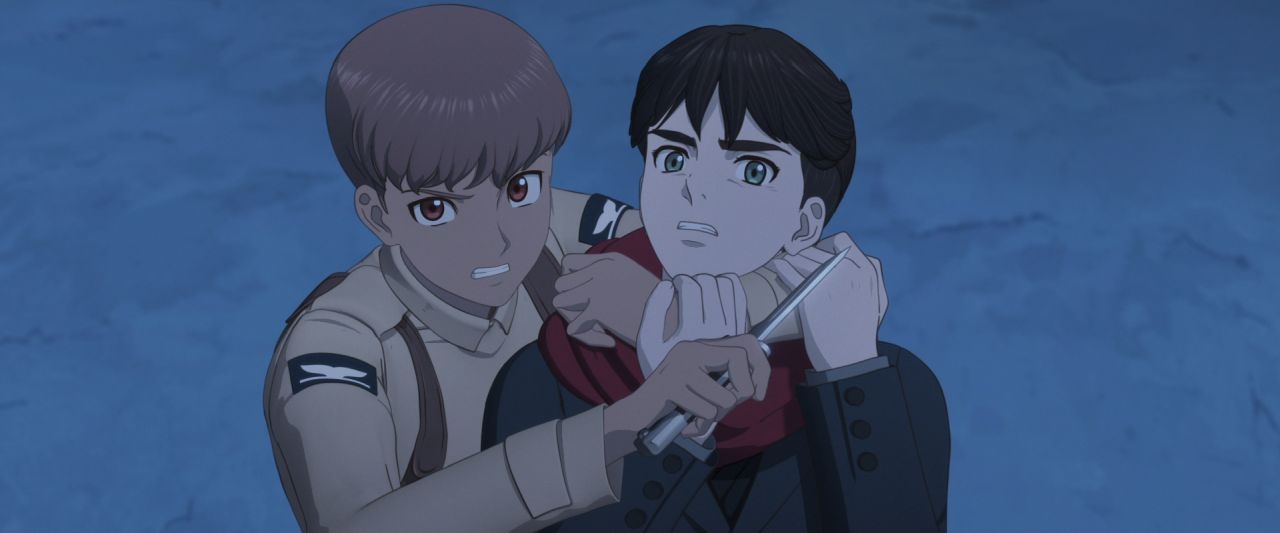
And… we actually learn very little about Dylan’s backstory, with the focus far more on her pluck and insolence. She’s presented as lean and androgynous, and some Orange fans might link her to the crystal characters in Land of the Lustrous, who were emphatically non-binary. I was also reminded of Oban Star Racers, another anime with French directors, whose heroine adventures under a false identity, though she doesn’t fake her sex.
Alek and Dylan meet soon enough – Alek is in the process of being evacuated by his adult guardians when he comes across the Leviathan, crash-landed in the Swiss mountains. In honesty, this was where I thought the show slackened badly, after two enjoyable opening episodes. The problem’s not so much with Alek and Dylan specifically, but rather the cast as a whole. There’s just not enough of a sense of tension between them, something anime excels at so often. Think of comparable anime adventure yarns, such as Laputa, Steamboy and Nadia: The Secret of Blue Water.
This problem’s exacerbated because there are no real enemy or adversary characters until very late in the show. Until then, they’re mostly just faceless soldiers or one-scene characters. I only really enjoyed Leviathan again when the action had moved on to the rebellious city of Istanbul (shaking off its old name of Constantinople). That’s when the series introduces a clever new love triangle between the younger characters. It’s sweet and wholesome, but it shows that Netflix is freer to depict certain kinds of attraction than Disney or Pixar.
Then again, some anime fans will be disappointed by how Leviathan’s love-triangle subplot is curtailed, midway through the series. Those same fans may be dissatisfied by the basic relationship between Alek and Dylan. I’m sure umpteen fanfic writers are already changing the story to make Dylan a gay boy, non-binary, a trans girl or a trans boy, and link Dylan with Alek on that basis. Ironically, that would be taking things further than most mainstream anime would go, never mind Hollywood animation.
But Leviathan’s final episodes still present a lively New York full of air transportation in the tradition of Fritz Lang. (For the record, Japan was animating such visions in 1932; look around 15 minutes into this video for an excerpt from a short called The Plane Cabby’s Lucky Day.) In general, the fantastical imagery is strong and engaging, and there are impressive “action” scenes, whether a fencing match or a well-staged musical interlude (Episode 7). However, the characters often have the familiar puppet-like quality of TV CG characters – the humanoids in Land of the Lustrous were far more balletically dynamic.
The show throws in seeming homages to Christopher Nolan films, both in the depiction of a certain historical figure and some familiar-sounding music at the exciting climax, which is full of electric rays and rampaging robots. The end is satisfactory, though with enough loose threads to suggest Orange might consider a sequel if Leviathan’s ratings are high enough.
I came into the series hoping to love it. It’s the kind of story I’ve long enjoyed, ever since I thrilled as a kid to Disney live-action adventures like 20,000 Leagues under the Sea and the less-remembered The Island at the Top of the World, with Vikings and volcanoes. And I did enjoy Leviathan in the round, though I found some of the episodes a chore and was disappointed not to see, for example, an appearance from the young Winston Churchill, who’s often namechecked in the script. If I was marking it critically, I’d only give Leviathan 7 out of 10, though in my heart I’d rank it higher, just for things like the flying whale.
Anime’s steampunk tradition
As mentioned above, Leviathan may be a series that some fans reject as not “proper” anime, even as Mazandarani suggests it’s the kind of show that’s needed for the industry to prosper. But in the last part of this article, I’d like to point out how Leviathan falls into a genre that’s been very successful in anime and very unsuccessful in Hollywood films, including animation: steampunk.
Steampunk is a fuzzy genre – for example, some purists argue it has to be set in Victorian times, which would rule out Leviathan. But the Netflix series has the genre’s core charms – the mix of a faraway historical setting and fanciful, sometimes outrageous technology, like flying whales. Hollywood’s steampunk films, though, started flopping with 1999’s Wild Wild West and have never recovered since. Witness the crash sites of The League of Extraordinary Gentlemen (2003), The Golden Compass (2007) and 2018’s Mortal Engines, the biggest commercial disaster no-one remembers. I’m particularly irked by the latter film, which ruined the wonderful source novels by Philip Reeve.
Hollywood animation too, has stumbled with steampunk, starting with Disney’s 2001 Atlantis: The Lost Empire and the following year’s Treasure Planet. In 2022, Disney returned to the genre with Strange World, another commercial disaster which people barely remember three years on.
Whereas in anime… well, steampunk is not that big a genre, but it’s infused an impressive number of landmark titles. Here’s a video-led display of some of the best. First, an early specimen - Hayao Miyazaki’s 1986 Laputa: Castle in the Sky, on HBO Max:
Though Miyazaki was playing around with steampunk back in 1984’s Sherlock Hound; there’s an official stream of an outstanding episode below.
Miyazaki returned to steampunk twenty year later with 2004’s Howl’s Moving Castle.
Hideaki Anno’s contribution was the 1992 TV series Nadia: The Secret of Blue Water. It starts as an ebullient kids’ adventure, but it ends up originating many of the themes (and much of the angst) of Anno’s Evangelion.
Mahiro Maeda’s outstanding 2004 series Gankutsuou: The Count of Monte Cristo reimagines the Dumas novel in a gothic, luminous world that mixes past and future. You can watch it on Crunchyroll.
Then there’s the ebullient 2017 spy-girl series Princess Principal, set in a divided Britain, whose scenario has debts to H.G. Wells (Cavorite!) and Mark Twain.
For anyone seeking a steampunk equivalent to Attack on Titan, look no further than 2016’s Kabaneri of the Iron Fortress, where a giant train ploughs through zombies in a medieval-style Japan. It’s on Crunchyroll.
Who could forget anime’s biggest steampunk spectacle of all, when Akira director Katsuhiro Otomo released his film Steamboy in 2004?
But my last link, in recognition of Leviathan’s French director, isn’t to an anime but rather to a French cinema film which deserves far more recognition. 2015’s April and the Extraordinary World was directed by Christian Desmares and Franck Ekinici and inspired by the designs of comics legend Jacques Tardi. You can see this excellent film on Apple TV, YouTube and other platforms.