Andrew Osmond discusses 2 vintage series, one made when the premise of being reborn into a new world wasn’t yet a hackneyed trope, the other about ordinary, everyday lives that’s far from just a ‘slice of life’ tale.
The anime serial Haibane Renmei was broadcast in Japan in 2002, A strange, beautiful series, it seemed to forecast a huge amount of anime trends over the next two decades, while standing gracefully apart from them. In America, it can be purchased from Amazon or streamed on Apple TV.
Haibane Renmei was made when the premise of someone being reborn into a new world wasn’t yet a ubiquitous anime trope, as hackneyed as oversized mecha or schoolboys with superpowers. In fact, the idea had hardly been used in anime at all, and it was a source of wonder, not a pretext for nerd jokes about power levels and smartphones.
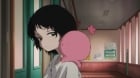
In the show’s opening moments, a girl floats in a cocoon, waiting for birth into a new world. Through the amniotic-like fluid, she hears voices outside, the conversations lively but oh so faint. It suggests the promise and potential of life, but also a soul in isolation, shut out from humanity.
The cocooned girl is “born” as a young teenager, finding herself in a huge old house with five other girls of similar “ages.” In a touch of all-out whimsy, she receives a halo that makes her hair stick up. But there’s no whimsy in the wings that emerge agonizingly from her back, a sequence played as another birth, full of blood, screams and wonder. There’s little in anime to match it.
The girl, named Rakka, is a being called a Haibane. She was born into this world after dying in ours, remembering only birds and falling; her given name means falling. The series is an afterlife fantasy without battles, villains or quests. If you insist on making a gaming reference, then it’s set around a genteel town where an RPG gamer might sleep between battles. But crucially, Haibane Renmei is a character drama, whose cast of girls, more charming than cute, experience friendship, loss, despair and redemption.
The show’s fantasy is mysterious, throwing up many unanswered questions. But the human story is built meticulously and clearly; it becomes moving and spiritual in sacred and secular senses. The fantasy world is still unsolved at the end, even as the human story resolves in a sublimely satisfying way, making the 13-part serial unusually complete by anime standards.
Small world
Rakka’s new world consists of the stone house (“Old Home”), and the town and country outside. The town looks old-world European and is populated by ordinary, wingless humans who regard the Haibane with distant fondness. One woman coos over Rakka as if she was a lucky charm. The countryside has woods and wilds and a temple of priests with concealed faces. They maintain the wall that surrounds this small world, which the characters can only cross one way.
The early episodes are slow as Rakka explores her new home, meeting friendly people, with cute moments, little outings and mild conversations. The sense of community in Rakka’s home and town, and the old European architecture, sometimes makes the series feel akin to Miyazaki’s Kiki’s Delivery Service.
Like Kiki, the series treats the characters with fondness without ever indulging their cuteness (or hardly ever). Apart from Rakka, the most important character is Reki, who immediately takes the role of the younger girl’s guardian and big sister. Reki is anything but cute; she’s strong and kind, but she’s defined by deep shadows that Rakka can’t comprehend.
Into the dark
Until those same shadows fall over Rakka too. Haibane Renmei’s story kicks in at around the halfway point, in the sixth episode. Here, an unforeseen development leaves Rakka stricken, even suicidal. It’s not one of the extreme changes in tone that I discussed two weeks ago, but it’s pungent.
From then on, the series becomes powerfully compelling. Wells and undergrounds rivers are imbued with holy force. By the last episode we’re into a dark psycho-drama, with Rakka fighting for a tortured soul. The appealing character designs are sometimes animated crudely, though with touches of great delicacy. But as the drama darkens and the characters move into woods and winter, the images become grandly evocative. The series was animated by the Radix Ace Entertainment studio, which closed in 2006.
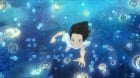
The orchestral score, from the lush opening theme – one of the best in anime - to minor-key lullabies, is superb. It’s written by the Gundam Wing composer Kou Otani, whose other credits range from Outlaw Star to Keiichi Hara’s Colorful - a film that has thematic resonances with Haibane Renmei, though it’s not as good. Rather than being set in a fantasy world, it involves a nameless soul getting a second chance in this one.
Some viewers might complain that Haibane Renmei never pulls back the curtain to reveal its hidden truth. In other words, the series never becomes Dark City or The Matrix or umpteen “fake world” stories. But its characters fight and suffer, risk and sacrifice for the things that are most real to them; namely, the people they love.
Drifting down the river
Much of the appeal of Haibane Renmei is in its characters and mysteries. Yet its poignant tranquility, at least in its first half, is also a large part of its spell. And that connects the series to many other anime of a certain type, or perhaps two or three overlapping types.
Three years after Haibane Renmei, another series became known as a paradigm of tranquility. The 2005 anime was Aria: The Animation, available on Crunchyroll. It was made by the Hal Film Maker studio, a year before it collaborated on the French-Japanese series Oban Star Racers.
In Aria’s first moments, a drowsy song plays over a Venetian scene: handsome white brick houses along a canal. (The setting’s actually Mars, but that’s largely unimportant.) Inside one house, two girls prepare breakfast. The younger girl listens to the whistle of a kettle, and the mewing of the house’s cat swaying on the chair, and she comments how these little sounds make it feel like the day’s getting started.
In a later episode, this girl, called Akari, is staying at a cabin with more girls her age. They’re the guests of a kind old woman, a legend in their line of work, which is steering gondolas. The girls all wonder how they could ever reach their host’s level of excellence. Smiling, the woman tells them the trick is to make your everyday life fun, and accept even sad days as a flavor with which to enrich your life; to take what comes your way, and then change it within yourself. You may remember a Disney nanny who sang about a spoonful of sugar.
There are three obvious things about Aria, and also much of Haibane Renmei. One is how mellow these series are. Their tone is calm, relaxed, unhurried. In Aria particularly, there’s almost nothing that could be described as a threat or a conflict. In Part 1 a cat inadvertently floats off into the middle of a canal in a wooden bowl, and another cat gets mislaid later, but even these panics are mild and brief. Very occasionally, two characters might get annoyed with each other, but you know it’ll all be sorted out swiftly.
Aria is about as mellow as a TV show can be without Teletubbies in it. If you hear anime fans use the world “iyashikei” – which can mean “healing” in Japanese – then they’re highlighting this mellow tendency, anime that minimize conflict, anger and threat.
Of course, this mellowness is a matter of degree. Many anime have this lulling quality for some of their running-time, before changing lanes, like Haibane Renmei. Even the blissful country idyll of Hayao Miyazaki’s My Neighbor Totoro pitches into something darker in the last half-hour. Other anime films use “peaceful” stretches where we know the peace must end. But these stretches last long enough so that the audience stops waiting for the storm, and starts appreciating the calm instead.
One case is a film I’ve discussed previously, In This Corner of the World. It’s set around wartime Hiroshima, and the clock is ticking down to August 1945, but you can forget that amid the succession of quiet domestic episodes. The final Evangelion film in 2021, Evangelion 3.0+1.0: Thrice Upon a Time, has a sedate first act in a country backwater village, even while humanity is fighting for its survival. This “rest” lasts nearly 40 minutes and made us adjust to its rhythms, before the giants started fighting again.
The delightful 2022 film Gundam: Cucuruz Doan’s Island does much the same, despite the impression given by the action-centered trailer above. It’s enjoyable even if you’ve never watched the Gundam franchise before. The film’s about a boy soldier forced away from his weapons when he’s marooned on the title remote island. Here he encounters a group of kids who become his surrogate family, and who remind him he was once a kid like them, not long ago.
The Moe factor
Gundam: Cucuruz Doan’s Island is notable in being centered on a boy. Many mellow anime are predicated on the notion that mellowness needs female leads. This is the second of Aria and Haibane Renmei’s converging qualities – their focus on females, often teen girls. Two phrases often thrown around by fans are moe – a Japanese word which means something like “endearing” - and “cute girls doing cute things.” Notably, though, neither Aria nor Haibane Renmei are usually concerned with moe.
As used by fans, moe refers to a level of hyper-adorability, overlapping with idol culture. But it’s only the extreme end of a spectrum, running through the tranquil gondoliers of Aria, to the wonderfully eccentric, idiosyncratic heroines of Shunji Iwai’s The Case of Hana & Alice. The latter film is a lovely comedy of errors that could be described as “kooky girls doing kooky things.”
Slice up your life
Then there’s a third strand in Aria. It’s how the series depicts the characters’ “ordinary” lives; waking up, interacting, working, resting, small mishaps, small lessons, then off to bed for the day to follow. Here the phrase fans like is “slice of life.” Or they might use the Japanese word “nichijou,” meaning something like “everyday.”
Some fans use the “slice of life” tag to highlight when an anime feels plotless, with little obvious narrative thread. That’s true in Aria, though that series is carefully structured. As it goes on, the girls get more used to each other; we learn progressively more about them and their interactions. There are little subplots, hinting of timeslips and friendly ghosts. The seasons change, summer skies giving way to snow.
While the excesses of moe may come from the fan culture of the 1980s and ‘90s, the other strands go back a long way. If you’re Japanese, they go back to the anime of your parents and grandparents. Perhaps the two most important titles are Sazae-san and Heidi. Sazae-san is the world’s longest-running TV cartoon; it started in Japan in 1969, and it’s still running now. It’s a genteel family comedy about a housewife and her family. It’s seldom mentioned by Western fans, but it’s part of anime’s bedrock.
As for Heidi, that was a massively-loved family TV series in 1974, directed by Isao Takahata from the nineteenth-century story about a girl’s life in the Alps. The years-long series did have an overarching story, but it was told at deliberate leisure to let viewers appreciate life’s minutiae. Heidi influenced dozens of other family cartoons, and it’s one of the most important ancestors of Totoro and its descendants.
It’s hard to think of many equivalents to Sazae-san and Heidi in American animation, except for cartoons aimed squarely at infants and the parents watching with them. Perhaps the best breakouts are the Charlie Brown cartoons. However, those unsentimental tales of childhood have more rueful disappointments than the sunnily optimistic Heidi and Aria in Japan. Then there are the American cartoon sitcoms about domesticity, but they’re punctuated by raucous humor and cartoon violence.
That’s not to say the demand for animation nearer Aria isn’t there. If I can be a little mischievous, I might point to the furor in the 2010s over My Little Pony: Friendship is Magic. If anyone on this site doesn’t know, that was a cartoon for little girls which ended up gaining a huge adult fan-following. The press, predictably, focused on the male “bronies,” and ignored the just-as-vociferous adult female fans.
The toon’s moe qualities were obvious. But judging by fan comments, there was also something very mellow – maybe even “iyashikei” – about watching the exploits of cute ponies, and of course they were girl ponies. True, the ponies could get much crosser with each other than Aria’s gondoliers ever did, and they also fought epic equine battles to save their world. But maybe there’s a baseline similarity.
Japan, of course, has its own pony cartoon. It’s Uma Musume Pretty Derby, and it “humanizes” horses as girls running around a racetrack… Yes, I know, I know. But it’s possible to imagine a pony anime more in the spirit of Aria. It could have cartoon horses touring through the countryside, running joyfully through the woods, and sometimes riding a barge on a river for a change of pace. We could join them waking up at sunrise, making breakfast, and commenting how the small sounds all around make it feel like the day’s getting started…