
Andrew Osmond looks at anime about people transported to fantasy worlds, and argues they come from very different traditions – some very old, and some very new.
An ordinary person, unhappy in his or her life, is transported to a fantasy world full of strange characters and beings. It’s part of an anime tradition, but which tradition? It’s easy to use labels like “isekai” – a Japanese phrase meaning “other world” that’s routinely applied to these kinds of stories. Or you can invoke Western books like Alice in Wonderland or The Wizard of Oz
Actually, anime about going to other worlds don’t belong to one tradition. Rather, it’s a schism. On one side are anime rooted in literature going back centuries. On the other are anime rooted in more recent media, especially online fanfic. Each of these strands do different things and have different agendas. You can see them as enemies, though you can also enjoy both.
The Emperor of the Sea
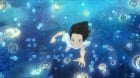
I mentioned Western books a moment ago, but Japan has its own stories about folk going to other worlds; stories like “Urashima Taro,” which originated more than a thousand years ago. In the best-known version, a fisherman saves a baby turtle from cruel children. He’s then visited by a huge turtle that announces the baby was the child of the Emperor of the Sea, and he wants to thank the rescuer. The fisherman is brought to the sea bottom, meeting the Emperor and his child, in the form of a beautiful princess.
The fisherman spends three days in the palace and then asks to leave. But there’s a terrible catch. He’s returned to the surface… but hundreds of years have passed in the world above. He opens a box he was given under the sea, only to be transformed into a tremendously aged man. Everyone Taro knew and loved is dead; he’s a man out of time. Here’s a silent version of the story, compressed into a minute.
The story influenced famous anime, though not ones fans call isekai. In Cowboy Bebop, Jet tells Ein the story in an episode about Faye Valentine, a similarly time-lost character. Hideaki Anno cited “Urashimo Taro” as an influence on his video series Gunbuster, whose space heroine experiences time dilation, speeding up reality around her. But my favorite is Mamoru Oshii’s comedy film Urusei Yatsura 2: Beautiful Dreamer which riffs brilliantly on the story (and anticipates Groundhog Day long before it was made).
More classic “other world” stories came to Japan from the West. Lewis Carroll’s Alice’s Adventures in Wonderland and Through the Looking Glass had nearly 200 Japanese editions in the 20th century. For more on Alice’s impact in Japan, read the wonderful book British Children’s Literature in Japanese Culture by Catherine Butler.
The start of the last century also saw Peter Pan from Britain and The Wizard of Oz from America. Both books became lengthy anime in the 1980s; in fact, you may have watched them without knowing they were anime at all. The Oz anime had a dub narrated by Margot Kidder. The Peter Pan series had a slightly Luffyish-looking Peter - it predated One Piece – and was distributed by Saban Entertainment.
These stories seeped into Japanese culture, and many anime strive to capture their spirit. In Hayao Miyazaki’s Spirited Away, the witch Yubaba looks very like the huge-hatted “Duchess” character drawn by Sir John Tenniel in his Alice illustrations. More fundamentally, Spirited Away, and related anime keep the wonder from the children’s print classics. Their fantasy worlds may be riotously fun or darkly scary, but they’re always amazing.
Beyond Alice, Spirited Away was influenced by a Japanese children’s book. The Village Beyond the Mist was written by Sachiko Kashiwaba, whose books go back to the 1970s. Kashiwaba was influenced in turn by foreign fantasies such as C.S. Lewis’ The Lion, the Witch and the Wardrobe.
A Kashiwaba book had a direct anime film adaptation in 2019, The Wonderland (aka Birthday Wonderland), directed by Keiichi Hara. It’s very much in the mold of the original Oz stories, though with a sly twist – it’s not just a girl who goes to a fantasy world, but a grown-up woman too. In many classic fantasies, adults are blind to magic, but here a grown-up embraces it with gusto.
A Japanese twist
Many other anime reinterpret the classic fantasy template. Naturally, some wove in anime’s own peculiar tropes. In 1983, Gundam creator Yoshiyuki Tomino directed Aura Battler Dunbine, about a male motorcyclist who’s swept into to a world of monsters, warriors, and giant robot suits. In the 1990s, the same mix was used in the CLAMP-created series Magic Knight Rayearth and in Kazuki Akane’s beautiful Vision of Escaflowne, except their protagonists were schoolgirls.
Other series dropped the robots and swept their heroines to fantastical, magical versions of historical Asia: Fushigi Yugi, set in China, and Rumiko Takahashi’s InuYasha, where a holy well leads to feudal Japan.
Spirited Away suggests the Japan of Shinto gods. The film also serves as a comment on modern Japan, and how the country has forgotten its traditions. Mamoru Hosoda’s The Boy and the Beast (trailer above) sees a Japanese child blunder from Tokyo’s neon lights into a world of beasts, where he’s adopted by an ursine fighter, and grows to adolescence there. By the second half, the boy has roots in both worlds, as the story sloshes back and forth between realities. The climax erupts in central Tokyo.
Makoto Shinkai’s 2022 blockbuster Suzume is another distinctly Japanese fantasy, rooted in the trauma of the 2011 earthquake. Again, the film reworks classic fantasy traditions while respecting them. One of Suzume’s key images, of a wooden door standing by itself in a deserted resort, could be from a Narnia book by C.S. Lewis. But in Suzume the characters must seal such magic doors to stop terrible catastrophes pouring through. The journey to another world is taken by a stricken little girl. As in Birthday Wonderland, a grown-up must save this Alice.
Typically for a Shinkai movie, Suzume is set in a world of social media, on mobile phones especially. That’s very unlike some older classic fantasies, which despair of anything that needs electricity, let alone Wi-Fi. In The Wonderland, the main grown-up character is a shopkeeper, and her shop is full of shelves of colorful children’s books. Pointedly, there’s not a game cartridge in sight.
The “classic” fantasy perspective on newer media is encapsulated in a non-Japanese film, the 1984 live-action Neverending Story, which also has a bookshop owner. He irritably tells the little-boy hero, “The video arcade is down the street. Here we just sell small rectangular objects; they’re called books. They require a little effort on your part and make no beep-beep-beep-beep-beep.”
There’s a similar bookishness in newer fantasy anime, all based on books. In Studio Ponoc’s 2023 film The Imaginary, the gateway to multiple fantasy realms is through a library. Set in England, it’s based on a British novel by A.F. Harrold. I was interested, though, to learn that the script’s most touching elements, relating to a human girl and how she copes with great emotional trials, were added by its producer/scriptwriter Yoshiaki Nishimura.
When I interviewed him, he told me these elements were influenced by his own daughter, and her problems in elementary school. “She went through something that was quite challenging, and I think she was trying to send a signal, but I couldn’t catch it… She couldn’t go to school for a period of time.”
That connects The Imaginary to another recent anime fantasy film. Keiichi Hara, director of The Wonderland, went on to make 2022’s Lonely Castle in the Mirror, from a bestselling Japanese novel by Mizuki Tsujimura. The film has a particularly interesting mix of elements. It foregrounds the specifically Japanese issue of hikikomori, where people, often youngsters, refuse to leave their homes. (I interviewed Hara about the issue here.) But Lonely Castle’s scenario also echoes E. Nesbit books from a century ago, while the story explicitly invokes a Grimm fairy tale.
Then there’s Miyazaki’s 2023 Oscar-winner The Boy and the Heron. In a first-act scene, the hero Mahito is shown reading a book left by his late mother and being moved to tears. The book is a real Japanese book that Miyazaki admired, How Do You Live? by Genzaburo Yoshino. That’s not a fantasy story, but rather an encouragement to youngsters to think about the title question.
It’s less publicized, though, that the film was also influenced by a Western fantasy novel. The Book of Lost Things was written by the Irish author John Connolly and published in 2006. (If you look at the film’s end credits, you’ll find it acknowledged as an “influence.”) Like Miyazaki’s film, Connolly’s book is set against World War II, though it starts in England, not Japan. Miyazaki takes story elements such as a boy’s resentment against his new stepmother, and his conviction that his “real,” deceased mother might be in another world.
Not all “otherworld” fantasies come from this literary tradition, of course. It’d be remiss not to mention the American Dungeons & Dragons cartoon from the 1980s, inspired by the eponymous paper-and-dice role-playing game. A group of teenagers is blasted to a magic-and-monsters world by a rollercoaster. It’s not anime by most definitions, but it was animated for hire by Toei Animation, Japan’s largest anime studio.
But in the 2000s, a whole other kind of fantasy anime exploded in Japan. It didn’t come from books; it came from the net.
Naro novels
The origins of online isekai Japanese stories are explored in an excellent article by Kim Morrissy, on Anime News Network. It’s called, “Mushoku Tensei is not the Pioneer of Internet Web Novels, But…” The protagonist of the Mushoku Tensei series is a long way from Alice or Chihiro. He’s an adult reprobate with a vile past who gets killed in an accident, only to find himself in the body of an infant in a fantasy world. The story was adapted as an anime in 2021, but the original was first posted online back in 2012.
As Morrissy explains, Mushoku Tensei grew out of a long-burgeoning subculture rooted in fanfic. One major starting point was The Familiar of Zero, a series of light novels and anime in the 2000s. The story begins with a girl wizard in a fantasy world accidentally summoning a teen boy from Japan, who becomes her “familiar.” This spawned a ton of fanfiction on a Japanese website called Shosetsuka ni Naro (“Let’s Become Novelists”), or Naro for short.
The slew of Naro fanfics took the Familiar of Zero idea and warped it in umpteen ways – for example, with the girl summoning someone quite different. Eventually, Naro banned fanfic, but it didn’t matter, Writers could tell these kinds of stories without any overt reference to Familiar of Zero. Naro became flooded with stories of Japanese people travelling to other worlds, often by magic summonings, or reincarnations, or a combo of both. Think of how the comedy anime KonoSuba starts, with the hero getting smooshed by a tractor, then being immediately greeted by the lovely goddess Aqua.
Konosuba originated on Naro, as did Mushoku Tensei. So did Re: Zero, That Time I Got Reincarnated as a Slime, Overlord, Arifureta, Bofuri, Ascendance of a Bookworm, Infinite Dendrogam, How a Realist Hero Rebuilt the Kingdom, Wise Man’s Grandchild, and The Rising of the Shield Hero. And many, many more. Morrissy adds that not all Naro fiction can be traced to Familiar of Zero fanfic. An important exception is Log Horizon, which used the premise of characters trapped in a fantasy game. That idea was anticipated by a much older online story, Sword Art Online, which did not start on Naro; author Reki Kawahara published it on his own website in 2002.
Nonetheless, these stories share a “meta” sensibility that mostly runs against the wonders of classic fantasy discussed earlier. Alice and Peter Pan were written for children exercising their imaginations for the first time. The newer isekai shows feel aimed at badge-of-honor otaku who know how fantasy tropes go down and treat them like sport.
Often the protagonists in these series get dropped into fantastic worlds but barely lift an eyebrow. The worlds are often very samey and generic, so it’s hardly surprising when the characters are as jaded as we are. Had Spirited Away’s Chihiro been in such a series, she would have rolled her eyes when her parents get turned into pigs and started fighting the bathhouse ghosts to level up her power points. In another Anime News Network article, “What’s the Point of Isekai?” the commentator NineOuh suggests these series are smothered by self-congratulatory lampshading and wonder-killing power trips.
Defending Isekai
The worst of them are, no question. And yet the better stories have spontaneity and imagination that go beyond algorithms. Long before the slew of online isekai, other anime were made with fannish, knowing mindsets. How about Evangelion, which turned that mindset into an anguished, self-hating battleground full of chaotic, brilliant ideas?
Evangelion is echoed in the isekai Re:Zero, the genre “isekai” anime which has most impressed me. It’s a show that takes its confident otaku hero and puts him through loopy nightmares. His main torturer is the mad priest-jester-psycho Petelgeuse, who’s given to self-maiming, crazy contortions, and shrieking sermons. Petelgeuse is, simply, brilliant; he could have stepped from the literary Gormenghast fantasies by Mervyn Peake.
The bold beginning of the “Alicization” arc of Sword Art Online removes the hero’s memories. He becomes an innocent in a strange land, helping his friend topple a demonic tree. Some fans found it deathly dull, but it was far from generic; it was experimenting. True, the “Alicization” arc also included a notorious scene of sexual assault, like older SAO fare. But when the anime was broadcast, Reki Kawahara Tweeted an apology. He said the scene was influenced by stories he read as a schoolboy but that “the spell has finally worn off.”
In other words, Kawahara wanted to grow as a writer, and he recognized that some of the writing that influenced him was schlock. But there are always better things to learn from. After all, “Alicization” revolves around a little girl called… Alice.
Even when the fantasy elements in an isekai are generic, the human elements don’t need to be. Take Grimgar, Ashes and Illusions, which didn’t originate on Naro but shares the same tropes. Reviewing it for a magazine, I wrote, “It’s about kids in a world of magic and monsters, but that’s really window-dressing for a story of people coming to terms with death, grief, and their own mortality, and how the sun still rises whether they want it to or not… (It’s) as if characters in throwaway video game battles were suddenly bleeding and weeping and clinging to one another.”
A grump like Neverending Story’s shopkeeper, or Hayao Miyazaki, would scoff. They’d say that online isekai are written by people who’ve never read “proper” fantasy; people who know fanfic but not Narnia or Neverland. But amateur writers grow into those things, and they can discard the crutches of formula fantasy when they’re ready. You can complain the online eco-system leads fans to copy their peers, but they’ll also see the best writers trying something new.
It feels good to write a story that satisfies your readers’ expectations. But how about writing a story that startles them because they’ve never read anything like it before? A story that makes you feel like you did reading Alice as a child, or “Urashima Taro.”




#/media/File:Alice_par_John_Tenniel_32.png)