Columnist Andrew Osmond looks over 5 new TV anime, including Science Saru’s ‘Sanda,’ the romantic ‘Let’s Play,’ a new ‘Digimon, the girl-meets-wolf ‘With You, Our Love Will Make It Through,’ and the space mystery ‘Gnosia.’
A new TV anime season began this October. This week I’ll look over five new shows, all accessible to “new” viewers (though I’ll put them in historical contexts). They’re all streaming on Crunchyroll, barring the first title, Sanda, which is on Prime Video.
Sanda – Since its inception in 2013, Science Saru’s track record has been so strong any new series comes with the expectation that it could be “the” anime of the season. That’s doubly so in the case of Sanda - it’s an action-comedy, like Saru’s hit Dan da Dan. Sanda’s director is Tomohisa Shimoyama, whose animation credits go back before Saru to titles such as Paranoia Agent and Summer War. His Saru credits include Animation Director on the film Night is Short, Walk on Girl.
Sanda’s premise can be summarized as “superhero Santa,” an idea probably toxic in Hollywood for a while after last year’s Dwayne Johnson disaster Red One. The story throws so many curveballs that it’s best to spoil the minimum. “Sanda” is a boy in a plainly unhappy future, where Japan’s economy and climate are on a terminal slide, kids are a tiny minority in an ageing country, and Christmas is dead, a relic of the past. Except that Sanda’s girl classmate is determined to bring it back, and soon there’s a giant in the school, with a white beard and a bellowing laugh.
We’re hurtled in with terrific character animation and funny designs. The kids have strong black outlines and huge goofy mouths while Sanda’s obsessed classmate, called Fuyumura, is like a mad kitten, pupils tiny in bulging white eyes. Music and color play active, dissonant parts; the first scene sets a knife-wielding attack to a perky spring tune. Thematically, Sanda’s out to say something new about the relationship between children and adulthood. One villain embodies Japan’s fetishization of youth, while a central transformation builds on vintage “magic girl” shows (one example) where children turn into adults and back again.
Yet Sanda’s first two episodes have left me agnostic. For all the gratifyingly crazed action, it’s thin on character chemistry or scene-setting – much of this world is explained in functional info-dumps. There’s a severe lack of Christmas spirit so far – this Santa’s heroically benign, but it’s translated into jollity. You need only think of A Christmas Carol to imagine how jollity could be ramped up into something manic and maniacal by Science Saru.
In the past, I’ve thought Saru sometimes let down terrific premises with executions that are impressive yet joyless and inert. That was my reaction to the studio’s two apocalyptic titles, Devilman Crybaby and Japan Sinks 2020. (Though I preferred the latter – my review is here). For now, I’ll continue to watch Sanda and hope. Oh, and this Santa show is not for kid viewers, with a blithely imitable (and disturbing) act of violence in Episode 1.
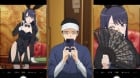
Let’s Play – It’s a bright sunny morning and a woman in dowdy grey clothes walks a dog through a park. Suddenly she sees a vision of terror approach – a young male jogger, shirtless, his ripped torso shiny with sweat. It’s an acquaintance the woman, called Sam, does not want to talk to. She scuttles behind a tree, but she’s forgotten an important detail. The man sees a puzzled dog on a lead, the other end trailing behind said tree. A moment later, Sam blinks against the sheen of the man’s torso as he bids her good morning.
It’s a small joke, but I found it funny, and it’s one reason why I’ve warmed up to this rom-com, animated by the Pokémon studio OLM. Very unusually, the anime is based on a strip by an American writer/artist, Leeanne M. Kreic (aka “Mongie”). AWN’s Victoria Davies has already reported on how the strip had to be changed for the Japanese adaptation. Torsos were an issue, said Kreic; the men may be ripped, but Kreic wanted them beefier, which doesn’t fly in today’s Japanese market. (Then again, one of the most respected gay manga writers, Gengoroh Tagame, made a whole career out of beefy men.)
I can’t remember an anime that reminds me so much of a Richard Curtis film, for better and worse. At worst its rampant unsubtlety is doused in crassness. Episode 1 will raise hackles with a scene between Sam and a male boss, crashing chivalry into creep territory. In Episode 2 the shirtless man encounters much younger girl fans, reacting in exactly the wrong way.
This is a gamer romance – Sam is both a devoted player and a game developer. (It’s not the first anime of its type – I liked 2017’s Recovery of an MMO Junkie, though its reputation was sullied for reasons unrelated to its content.) I’m not a gamer, but some story points seem daft even to me. For instance, the ripped man in the park is “Marshall Law,” a globally popular gamer on YouTube. Yet he’s so dim that when he reviews a game Sam made, he can’t see it’s subverting game tropes; he can’t work out how to play it; and he trashes the game as a result.
We’re meant to believe this leads to Sam’s game getting trashed online, even though it’s shown that many players understood and praised it before Marshall tried it. (In the real world, it would be Marshall being trashed by pundits hungry for his status.) Then Marshall shows up as Sam’s new neighbor, to her confusion and fury. As a way to get a rom-com rolling, it’s as subtle as a sweaty torso, but it’s funny. As a representation of games culture, it feels as gauche as the Mrs. Doubtfire scene where Robin Williams stood before a beautiful American cartoon, fully drawn, and filled in the voice. (The stupid thing is that it would have been fine if Williams was dubbing anime.)
Let’s Play looks unlikely to subvert its own rom-com tropes, including Sam’s troop of loyal allies at her local coffee shop, who she seemingly barely notices. It seems so brashly obvious that I was writing the show off midway through Episode 1. And yet I soon started liking it again. Partly because of scenes like the park encounter. Partly because of adroit payoffs, like a reveal in Episode 3 that Sam has a deeper relationship with some café friends than it first appeared. It’s also because of the show’s funny fake-outs, when scenes turn out to be a character’s imaginings. Sometimes the fake-outs are obvious, sometimes not.
The series looks terribly bland early on, but it can come to life when Sam’s baffled and bothered by events. There’s a lovely-timed moment when she distorts in terror as Marshall taps her on the back… and it’s another well-played fake-out. True, much of her animation comes from Sam’s Japanese actress – Kana Hanazawa, a star of the medium.
Finally, it’s still refreshing to see an anime rom-com with adults, to bring up one of my old hobby-horses.
Digimon Beatbreak –There’ve been many previous Digimon anime, and Crunchyroll has some of them. The franchise goes back to Digimon Adventure (on Hulu in America) which was broadcast in 1999, based on Bandai’s then-new “digital pet” game. But you don’t need to have seen any of these before Digimon Beatbreak.
On its own terms, it seems better than much children’s franchise fare – and this is a kid’s show, broadcast on Sunday mornings. The palette is bright, the backgrounds appealing and the action lively – some of it is stock TV cartoon fare, but there are moments of real energy, such as the first-person view of a character “drumming” the railing he’s walking beside.
That’s Tomoro, voiced in Japanese by Miyu Irino (Sora in Kingdom Hearts, Haku in Spirited Away). He’s our viewpoint, with strange powers even he doesn’t understand. We meet him in an ultra-high-tech, seemingly safe future world, but by the end of Episode 1 he’s being hunted by giant wolf-monsters and protected – maybe – by a brash spiky green gecko that demands his life-force in payment.
By Episode 2, the show looks to be settling into a familiar action-based format. Tomoro is drawn into a group of resourceful youngsters, each of whom has an animal companion. All the animals, benign or predatory, are “Digimon,” created by a glitch in the future tech that’s unexplained so far. The youngsters fight bad Digimon creatures, and they also offer a surrogate family for Tomoro after he loses his beloved big brother and finds himself hunted not just by monsters but also by the human establishment. The dangle-tongued gecko, meanwhile, takes the role of an aggravating kid brother. It’s indicated, though, that Tomoro has issues trusting all these newcomers, which might make the story more interesting than most battle fare.
Even as a “new” story, this may baffle many adults and perhaps some kids, though the kids may mind it less. From the start, the action swaps between the “real” future world, brimming with video screens and AI voices, and VR arenas with Tron blue grids where youngsters and Digimon team up and fight. Even the “real” world story is full of mysteries and unexplained rules, with references to a force (“e-pulse”) produced by humans, who “freeze” into a deathlike state when it’s drained away. By the end of part one, two youngsters have suffered this fate, including Tomoro’s big brother. At least it’s not a sacrificial girlfriend.
In other words, this is tonally nearer Doctor Who than Scooby Doo. (Plenty of elementary schoolers watch Demon Slayer in Japan.) I’ve written about the “roughness” of some kids’ anime elsewhere, but the Digimon franchise seems to go to the dark side especially often. I saw the first episodes of 2023’s Digimon Ghost Game, which starts with a giggling phantom turning a terrified girl into a withered centenarian.
I liked what I’ve seen of Digimon Beatbreak, but I’m an adult! I should add that the series is by Toei Animation, Japan’s oldest and largest studio, that largely specializes in kids’ shows - I’ve profiled it in this column. Toei Animation is itself part of the multimedia Toei Company, and Digimon is one of several Toei franchises, animated and live-action, which pull a simple trick.
For instance, Toei makes the 50-year-old live-action Super Sentai franchise, where teams of costumed warriors fight often wacky monsters. (The franchise began in 1975; from 1993, Saban Entertainment reworked it as Mighty Morphin’ Power Rangers.) Typically, each year the cast and characters were switched for new ones, so that new child viewers could get on board. Kamen Rider, a similar live-action franchise by Toei, operates on the same principles – that’s getting its own anime spinoff this season. So do Toei’s PreCure magic girl cartoon, and Digimon too.
Well, some of it does. As I mentioned, the first Digimon series, Digimon Adventure, was broadcast in 1999. For many American fans, this is the Digimon series, featuring characters like Tai, Matt and Izzy being transported into the Digimon world. They returned in a sequel series, Digimon Adventure 02 and a much later remake show. They also figured in a couple of sequels aimed at older, nostalgic fans, Digimon Adventure Tri and a film, Digimon Adventure: Last Evolution Kizuna, which had the characters themselves growing up.
However, the rest of the copious Digimon franchise follows the principles of Super Sentai and PreCure. Each new show, including Digimon Beatbreak. brings in new sets of characters, human and digital, for a new generation of kids. Although I suspect there are plenty of older Digimon fans following Beatbreak too.
A last word: even if you’re a Digimon newbie, you might still find yourself on familiar ground with it, if you’ve seen the cyberspace anime films by Mamoru Hosoda, Summer Wars and Belle. Hosoda worked on the Digimon franchise early in his career, and Summer Wars drew ideas and images from a Digimon cinema featurette that Hosoda made in 2000. Called Our War Game!, it featured the original Digimon characters.
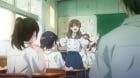
With You, Our Love Will Make It Through – An innocent schoolgirl finds herself strongly drawn to the new boy in the class. This time though, the boy, named Hadaka, is literally a beast – a wolf creature who towers over his classmates, is covered in soft fur, has claws, teeth and a tail… and is kind, gentle and sensitive. So far, so cute. That’s until an eyebrow-raising cliffhanger in Episode 1 that had me wondering if the show was about to go all Walerian Borowczyck. If you’ve not met the work of that Polish director, and sometime animator, then look up his 1975 film La Bete if you dare.
The anime is set in an “ordinary”-seeming Japan, except we’re breezily told in the opening moments that the population include a small number of “beastfolk,” bipedal animals, created by long-ago experiments. (No word if a doctor called Moreau was involved.) The beastfolk live in a small community with high walls, guarded by human soldiers, and they need passes to go out. The impression given in Episode 1 is they accept their lot – Hadaka’s dream isn’t to smash the system but to learn medicine and help his community. It’s also mentioned that beastfolk have a reputation for violence, so they’re only allowed in human society after careful screening.
Just those details alone could launch a thousand furious online diatribes. Of course, Japan’s history of race relations is different from America’s, but it’s still horrendous. A decade ago, the Attack on Titan franchise was pilloried by pundits convinced it was a supremacist screed, with a message that amounted to MJGA. I thought that argument was rubbish, but I was more convinced by charges laid against Ranking of Kings (a frequently excellent anime).
All that aside, I’m amusedly intrigued by With You Our Love... So far it looks to be much less sophisticated than Beastars – another school drama with animal characters, though Beastars has no humans. But it’s easy to be charmed at a show where a wolf boy’s tail wags involuntarily when a human girl is kind to him, or where the same girl tingles when she accidentally brushes the boy’s fur. Nearly all the signs are this will be a sweet teen romance, though the episode’s last minute makes one wonder. Those teeth. That growl. That drool…
Gnosia – As of writing, there's only one episode of Gnosia to go on. So far, its unappealing qualities incline me to drop it, though there’s an annoying possibility it could get better.
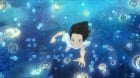
Episode 1 is a whodunit, or a “who is it?” A boy, Yuri, is thawed out on a spaceship, with amnesia that leaves him with an innocent, blank-slate personality. He meets four other crewmates, all female or feminine. He’s told one of the people on board is a disguised monster, the title “Gnosia,” who’s bent on murdering the rest. The crew must make regular votes; each time they vote, they seal one of their number in (perhaps permanent) cold storage. Their challenge is to catch the monster before it gets them.
It’s a traditional mystery, with little to commend it so far. The characters are dull types, or positively annoying in the case of one minxish seductress. The images feel simultaneously garish and flat, while silly picture angles and “camera” moves only add to the feeling of chintziness. The talkiness of the show presumably reflects its source material – Gnosia isn’t based on a comic, but on a “Visual Novel,” a kind of computer game where a branching storyline is told through dialogue with minimal animation.
Having been hard on the show, I confess Episode 1’s denouement does make me want to watch next week, just to see how on earth the story can continue at all, and if it’ll change and mutate interestingly enough to surpass Gnosia’s many shortcomings. Oh, and if your Greek is rusty, then the show’s name derives from the word “gnosis” – knowledge, particularly of spiritual mysteries.