Anime columnist Andrew Osmond looks at the spectacular new animated feature that premiered on Netflix last Friday.
This week, I’m looking at a feature film which debuted on Netflix last Friday. Lost in Starlight is a South Korean film, and as such I’d argue it’s clearly not anime, although other opinions are available. Been there, done that – I tackled the “What is anime?” argument in this column last January, through the lens of Castlevania.
What’s less contentious is that Lost in Starlight is influenced by anime; it could easily be mistaken for anime; and it offers many of the same pleasures as anime. I don’t think it’s a great film, but it’s tremendously enjoyable and very interesting as a comparative case study. It may even represent a milestone of sorts.
I discuss Lost in Starlight further down. First, though, some background re South Korea and anime.
South Korea’s Robin Hood and a country shower
South Korea has produced many animated films, of course. The country’s first cartoon feature was 1967’s The Story of Hong Gil-Dong, a lively if eccentric film about a Robin Hood-style hero who contends with cruel human authorities. It also had fantasy interludes, including a skeleton dance evoking Disney’s debut Silly Symphony. Hong Gil-Dong was a massive success in its home country, though it was later “lost” and only recovered through a couple of prints found in 2008 – in Japan, no less! I wrote about the film for another website.
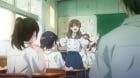
Of the other South Korean animated films I’ve seen, I was impressed by 2017’s The Shower (above), a 48-minute film telling the delicate story of a young girl and boy’s encounter in the country. It’s based on a nationally famous short story (written in 1959 by Hwang Sun-Woon) but Anglophone viewers may be reminded of the children’s interactions in Totoro. Or, indeed, of Makoto Shinkai’s 2013 The Garden of Words, another short story of friendship blooming in the rain. To repeat, though, The Shower’s story predates Shinkai by decades: I wrote more on it here.
I also enjoyed the 2016 zombie apocalypse film Seoul Station, an animated companion to the live-action Train to Busan. The director of both, Yeon Sang-ho, also made the gritty animated drama The King of Pigs (2011), which I found less digestible. But while I’m talking horror, I should recommend a live-action series on Netflix, Parasyte: The Grey. Excellent and inventive, it’s a South Korean reworking of a venerable Japanese source – the 1989 Parasyte manga by Hitoshi Iwaaki, about a person who gets merged with an intelligent “alien” parasite during a gruesome invasion.
In the original manga and anime adaptation, it was a Japanese schoolboy who was merged (what are the odds?). In The Grey, though, the character is a deeply traumatized South Korean woman, sending the story a very different direction. One of The Grey’s achievements is to cause problems for all those pundits who insist that it’s wrong to transpose an anime story to America and recast it with American actors. Hey, if South Korea can do it, then why not America?
Most AWN readers will know South Korean studios have also provided under-the-line work for mountains of animation produced by America and Japan. These studios include JM Animation, which animated much of Nickelodeon’s Avatar: The Last Airbender, which is one of the main shows held up by people arguing anime needn’t be Japanese.
Another Airbender studio, DR Movie, contributed to hundreds of anime titles, including the iconic Death Note. In 2022, the studio returned to that franchise, animating The Simpsons’ spoof of the show. Meanwhile, Studio Mir was founded in 2010 to animate much of Airbender’s sequel The Legend of Korra – Mir’s American-produced version of Devil May Cry hit Netflix this spring.
South Korea has also provided source material for anime. In recent years, God of High School and Tower of God were both based on South Korean “manhwa” strips, and Why Raelenia Ended Up at the Duke’s Mansion started as an online novel. But the series fans are fighting about now is Solo Leveling, a fantasy actioner based on another South Korean online novel.
This May, the series dominated the Crunchyroll Anime Awards 2025, largely determined by fan votes, where Solo Leveling took “Anime of the Year” and many other prizes. Cue arguments over whether that proved the supremacy of Solo Leveling, or whether it just shows the fatuity of an awards ceremony where “ordinary” fans pick the winners.
Lost in Starlight
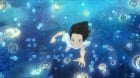
Back to Lost in Starlight, which is a densely-packed movie spectacle set in 2051. In America, the space program is back on track. One could take that as a vote of confidence in the visions of a certain Mars-obsessed South African billionaire. I prefer, though, to take Starlight as showing an alternate timeline where the history of the space program developed very differently, a la the live-action U.S. drama For All Mankind or one of my favorite anime TV series, 2003’s Planetes.
The lead of Lost in Starlight is Nan-Young, a South Korean who’s determined to travel on an upcoming mission to Mars - her astronaut mother was lost on a previous Mars mission. But despite her single-minded purpose, Nan-Young meets an unexpected distraction; the handsome, bumbling Jay, whom she finds exasperating but delightful.
One thing worth highlighting is the film is helmed by a woman, which is hardly common in animated features even now. The director, Han Ji-Won, previously made the 2015 feature Clearer Than You Think (trailer), 2023’s The Summer (trailer) and the short The Sea on the Day the Magic Returns (also 2023). None seem to have had much Anglophone distribution to date. However, Lost in Starlight’s seed was a 90-second TV commercial Han made which can currently be viewed here.
Interviewed by the Hollywood Reporter, Han specified she didn’t want the film “to look like Japanese anime (sic). I wanted it to reflect how young Korean people today look, dress and do makeup. That Korean-ness was important to me.” And yet, as a foreigner with particular blinkers – I know Japan’s pop-culture well, South Korea’s far less – I found Lost in Starlight overwhelmingly anime-ish. Would that my “trained eye” could tell the difference, but if I’d seen a Japan-dubbed version sans Korean lettering and place names, I’d have failed the taste test.
In particular – and judging by online comments, I’m far from the only person to think this – Starlight’s presentation feels heavily influenced by a director I’ve already mentioned, Makoto Shinkai. There’s the same shiny urban futurism and heavily compacted detail that was already in place in Shinkai’s 2007 5 Centimeters per Second (trailer), long before he was mainstream.
It goes past that, though. There’s also the fact that Lost in Starlight’s teasers and trailers strongly evoke an even earlier Shinkai film, his 2002 short Voices of a Distant Star. And if Lost in Starlight “grew” out of a brief commercial, the same is arguably true of Shinkai’s big breakout, 2016’s Your Name. That film was heavily anticipated by a 2014 ad campaign by Shinkai called “Cross Road,” about two converging youngsters who’ve never met – you can watch it here and I discuss the context here.
I’m not criticizing Lost in Starlight as derivative, though. Actually, it’s way less derivative than one of Shinkai’s own films – his disappointing 2011 Children Who Chase Lost Voices, which had Miyazaki-isms all through it. Starlight is also much better than a previous Netflix bid to make a post-Shinkai film. That was 2018’s Flavors of Youth, a Japan-China co-production which actually involved the “Shinkai” studio, CoMix Wave. “Flavors is respectable, but it often feels obvious and disappointingly dull,” I wrote in my review, though you can try it yourself on Netflix and the trailer’s below.
Ji-Won did acknowledge Shinkai as an influence in her interviews, though as part of a mix that also included Miyazaki, Satoshi Kon and Isao Takahata’s 1991 Only Yesterday. (I suppose there’s a slight analogy in Only Yesterday’s scenes of a young adult couple in the film’s second half.) Given one of Starlight’s strongest strands is the heroine’s determination to go to an impossibly remote place where her mother vanished, I can’t help but wonder if the film was also influenced by the 2018 series A Place Further Than The Universe, which I praised in this column a few weeks ago.
I don’t think Lost in Starlight is that good. That’s despite me loving super-dense urban spectacle ever since I saw Akira four decades ago. Starlight’s visual density is ferocious, but I didn’t get nearly enough sense of specific places, of where characters are from scene to scene, even shot to shot. The cutting is monotonously fast, in scenes where that’s perversely unnecessary.
Take the first scene in Nan-Young’s apartment. It’s the obvious chance to establish who Nan-Young is and how she lives. Instead, she has to contend with a call from a colleague who appears as a life-size hologram, as well as a bumptious mini-droid. The extraneous detail is so noisy that it’s a bar to the viewer’s immersion, even though we want to be immersed in the film’s beautiful world.
Starlight is also hampered by ridiculously murky storytelling in its very first minutes. There’s no mystery, no narrative intrigue, just lots of irritation. Right at the start, there’s a flashback with the mother’s fate on Mars. That’s followed directly by a scene with Nan-Young on Mars, which turns out to be both a VR simulation and a hallucination that Nan-Young is having within the simulation. Heck, if we’re talking Mars movies, I had enough uncertain realities in Total Recall!
Then there’s a rapid-fire backstory referencing three previous Mars missions – Nan-Young’s mother was lost on one. A more recent mission recovered artefacts from that tragedy, including an old-style record turntable that’s now in Nan-Young’s possession and becomes central to the film. But it’s all gabbled so quickly that I honestly wasn’t sure of one very basic point. Was Nan-Young involved on the third recovery mission, which would mean she’s been to Mars before?
No, she wasn’t, and that’s “more or less” indicated in the exposition, but it’s not spelled out as one simple line of dialogue could have done. That may just mark me out as a dumb viewer, the kind who needs everything shouted twice. But the recent release of the new Lilo & Stitch reminded me of what its director Chris Sanders told me about the original. He had to repeat one particular story point several times in the dialogue, that the adult Nani was the sister of the much-younger Lilo, rather than her mother or her aunt. When a story point is that fundamental to the film, it bears repeating.
Of course, Starlight has far bigger story issues. There’s a ridiculous coincidence regarding a demo music track that should have been thrown out in the first draft – there are tons of ways it could have been introduced believably. True, Shinkai’s blockbuster film Your Name was all about a thread of fate, but that was sewn into its story with care and elegance. I had much less trouble with Starlight’s suggestions of magic near the end, as the story’s main events are rationally grounded. But the music track coincidence? Nope, not buying it.
The music track links to a slow-revealed backstory about Nan-Young’s boyfriend, Jay, and the band he used to be in. And… well, the backstory might have worked in a TV serial with enough time, but it’s pitifully undercooked as a film subplot. If there’s an anime comparison here, it’s with the worst anime recap films, the ones that rush through a long TV story while leaving out the things which made it involving. In Starlight, you can practically see an “old-flame love triangle” plotline crashing to the cutting room floor.
And yet, as I said, I enjoyed Starlight greatly. Partly, I confess, I’m still a sucker for dense spectacle. It frustrated me for the reasons above, and I thought it was used badly at times, but darn it, the sheer volume of detail is awesome all the same. Some of the images in the closing 20 minutes are sensational; there’s a moment with Nan-Young running that looks like a tribute to Satoshi Kon’s Millennium Actress (2001), and it’s splendid enough to feel earned.
Such moments are so wholeheartedly overblown that they’re indistinguishable from “real” anime: a teardrop in zero-gravity, a radiant cosmic record-player. Then there are all the film’s blink-and-miss bits of tech, from driverless cars to foldaway wardrobes. There’s also the very unusual device (if you’re watching the Korean-language version) of having the astronaut characters switch blithely between Korean and English in the middle of a conversation, which “grounds” the film more believably than five minutes of techno-speak.
Partly it’s a relief to see an anime-style film with a grown-up couple in a grown-up relationship. So little “real” anime does that, as I ranted in this column not long ago. That Starlight feels Shinkai-esque is especially notable. Shinkai himself told me that he was thinking of depicting a grown-up relationship in a future film. Maybe he’ll use Starlight as a model.
The relationship between Nan-Young and her boyfriend Jay is well-served in the character animation. In the early scenes, it felt like the characters were drowning in the background details, but the main transitions of the couple’s relationship are drawn with charm and life, even in the painful moments.
There are inconsistencies. For example, during a (possible) break-up scene, the animation highlights Nan-Young’s expression when she makes a miserable decision. However, the low-frame rate in those seconds pushes the viewer out of the moment, much like the noisy backdrops in other scenes. (If you’re watching the film on Netflix, the moment I’m talking about is around 51-55.) Still, it doesn’t change the fact that the actual frames of Nan-Young’s expression are lovely.
Now I just want to see Han Ji-Won's animation backlist from the last decade, which looks very interesting from the trailers. How about it, Netflix?